Tip #1 to begin preparations for a journey where the signposts are unfamiliar, where the new worlds you see reveal elements in yourself that you never knew existed.
Headed to Kyoto? .... this capsule hotel stands out as quite an Adventure! Perfect accommodations for college age kids on a travel budget. Capsules are on our list of Japan Travel adventures. Click HERE for the Millenium Capsule Hotel in Kyoto
We haven't been north of Tokyo yet but we've added Yukigassen to our list of things to do in Japan: one of the world's most unique sporting events: the highly regulated snowball fight that began in Japan. Click HERE to view a Japanese snowball fight.
A long line of bibliophiles waited for Pico Ayer to sign A Beginner’s Guide to Japan after his comments, but I was more interested in a book he’d written 28 years earlier when he first arrived in Japan from the busy streets of Manhattan; The Lady and the Monk: Four seasons in Kyoto. 1991.
This morning Patricia, as we often do, read to me an interesting passage where Pico captures a form of Japanese intimacy: ai ai gasa, Japanese love symbolism.
There is lyric in Pico Ayer’s writing about Japan which compels me to nominate it to our list of Readings on Japan for those planning a visit. Just a few pages into The Lady and the Monk I can see how it will frame your upcoming visit to Kyoto.
I still want to know what moved Pico from his manic life in Manhattan to becoming a monk in a Kyoto Buddhist Monastery. One day I’ll sit down for a chat with him.
One of my earliest memories with Tommie comes from when I came to live with my mother Tamaki Ishihara Manzanares, I was 10 years old. She took me to Grandview Gardens in China Town where we were served tea while dining. She showed me the tea leaves remaining at the bottom of my cup while telling me she could see my future in those leaves. It would be 48 more years before I could walk the land of my Japanese ancestors. I still look very carefully at the bottom of my tea cup and have discovered that I can also see my past. Those remarkable days with her while growing up.
Part 1: Tea first arrived when Japanese Envoys returned from China in the 8th century. Though tea originated in China, it has become “one of the most quintessentially Japanese experiences" where guests
From Wikipedia: The Buddhist monks Kūkai and Saichō may have been the first to bring tea seeds to Japan. The first form of tea brought from China was probably brick tea. Tea became a drink of the royal classes when Emperor Saga encouraged the growth of tea plants. Seeds were imported from China, and cultivation in Japan began.
Tea consumption became popular among the gentry during the 12th century, after the publication of Eisai's Kissa Yōjōki. Uji, with its strategic location near the capital at Kyoto, became Japan's first major tea-producing region during this period. Beginning in the 13th and 14th centuries, Japanese tea culture developed the distinctive features for which it is known today, and the Japanese tea ceremony emerged as a key component of that culture.
In the following centuries, production increased and tea became a staple of the general public. The development of sencha in the 18th century led to the creation of distinctive new styles of green tea which now dominate tea consumption in Japan. In the 19th and 20th centuries, industrialization and automation transformed the Japanese tea industry into a highly efficient operation, capable of producing large quantities of tea despite Japan's limited arable land area.
Part 2: The Tea. A peaceful side trip just a few minutes away from busy streets of Kyoto.
The next time you’re in Kyoto... just 15 minutes away Reading Tea Leaves
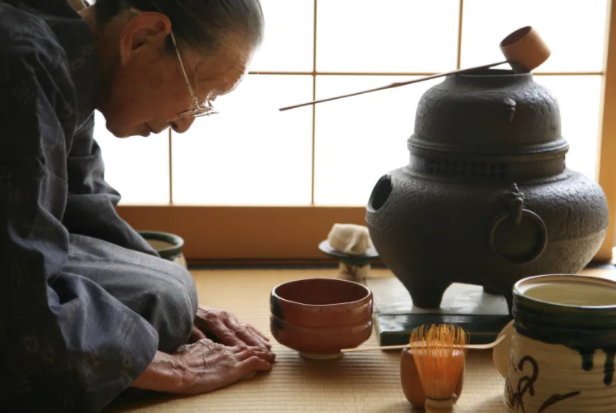
Part 3: A Culture of Peace: The Japanese Ceremony, Chanoyu, "Way of Tea, wabicha elevates hospitality to a form of art, a way of being. Guests take their shoes off before entering the tea room. Click Here for more about The Japanese Tea Ceremonywhich teaches us that "every meeting should be treasured because it can never be fully recaptured”. --Sen no Rikyu 1522-1591. In a Wabicha tea ceremony simplicity is held preeminent.
Photo credit: japan.travel
A Culture of Peace
Part 4: The History of the Tiny Tea Room Entrance click HERE.
Photo credit muza-chan.net
The nijiriguchi躙口 is a "wriggle-in” 60 by 65 centimeter entrance for guests in a rustic style tea ceremony room. Upon entering, first your hands, then your head, then one knee... symbolizing that all guests are equal in this tea room. The host uses the regular door.
Waiting for a table outside the Common Cafe in the APA Shinjuku Kabukicho Tower, Patricia whispers: “You’ve gotta see this!!!” Taking my arm like a co-conspirator in a mystery novel she pulls me through the door into a space the very definition of Shibui: spacious, simple, yet elegant. She’s drawn me into a beautiful room where I hear the soft sound of a running stream (designed to mask the sound made when even a delicate lady takes care of her “business”. She’s discovered the wonderful world of Toto Washlets, the most hygienic way for humans to ... well ... “take care of business”. That was our first together trip to Japan.
Is it possible that a scale was tipped at that moment?
I took her to Nara and Asuka Village on our second trip.
On our third trip, I proposed to her on a tiny island in Heian Shrine in Kyoto in three languages.
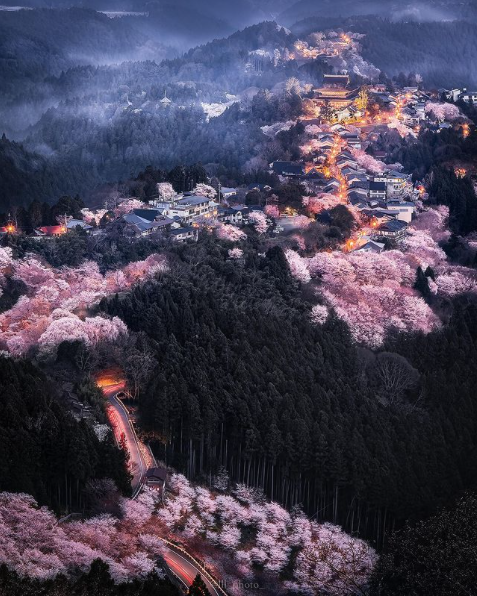
We were married under falling Cherry Blossoms at Senju Shrine in Tokyo on our fourth trip.
All those days, were experiencing the saving graces of Toto Washlets.
A short time after returning home from our Japanese Sakura Wedding, I visited a nearby Bath show room and brought home an easy to install S500e washlet for just over $1,000.
Chucke, install one of these for your wife... she’ll know that you’re a keeper for all the rest of her living days! Imagine her loving you more each time she takes care of “business.”
Imagine her sighing: “Oh... I love that man.”
The Lunar Japan is not hidden, but easily missed. Looking at the Japanese flag we see the rising sun, the logo of the industrial, political, global business side of Japan, but Japan’s hidden beauty is its lunar nature, the experiences that make us yearn to return as soon as when we depart.
The Geishas are hostesses having completed advanced classes in dance, instrumental music, poetry, calligraphy, traditional Japanese tea ceremony, and other fine and performing arts. Their education takes several years.
Shinto, no founder, no dogma, no commandments.
Naoshima, Art Island, east of Hiroshima
Art House Project integrates art into nature. Stay at a hotel that’s also an art museum.