
Saturday, February 16, 2019

Tip # 21 Use Google Translate!
Not yet 100% accurate and yet... an extremely useful travel assistant in Japan.


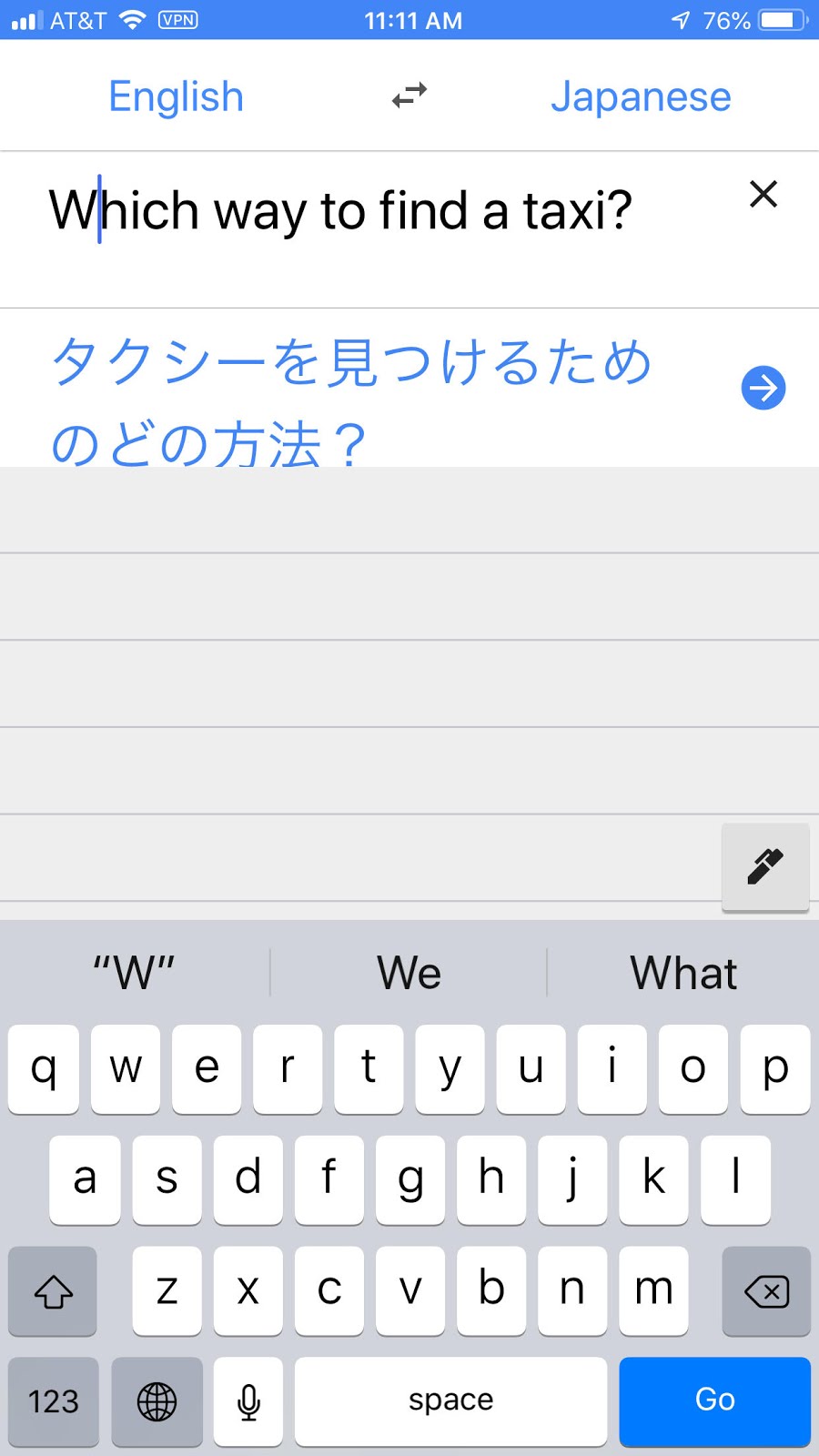
Let's try it on your phone.  Once you've downloaded Google Translate from you APP Store,  key in a term like:  Which way to find a taxi? 
Screen A pops up.  Look for and tap the round blue dot with an inset arrow ->

A.


Having tapped the blue arrow,  see Screen C below.

Next press the icon showing 2 microphones " (Con...sation) ... to turn on CONVERSATION mode.

When you say:  "Which way to find a taxi?" the app translates this into Japanese,  listens for the  Japanese response and translates it to English on your screen making possible an informative conversation!!!


 B.  


Press the speaker icon the translated Japanese blue zone when you are ready to:
Hear it...  and ...  Say it. 
I believe your earnestness shows well when you try to speak the language.
Worry not that your pronunciation needs work...  your extra effort will be appreciated.

Explore the two additional icons in the lower right corner of the blue field.

Monday, February 11, 2019

What do Blue Zones have in common?


The first principle of 120 and Beyond, and Blue Zones is...  Community. The Venn diagram above includes the terms Healthy Social Circle and Social Engagement.  But Community means much, much more.  Communities are social units with something in common, eg. norms, values, that share a sense of place (village, town), often with a common cultural and historical heritage.  Communities have durable relations beyond immediate genealogical ties, and have members who often share, intents, beliefs, needs, preferences, resources and some measure of cohesiveness.


So let us now build our own 120 and Beyond or Blue Zone Community.


Sunday, February 10, 2019


Maybe it's the people of Japan, or is it their culture, or their ancient history?

Or maybe it is something else, but ...


you are about to embark upon
“a journey where the signposts are unfamiliar, and where the new worlds you see reveal elements in yourself that you never even knew existed.”                     
Rick Ridgeway and Italian anthropologist Fosco Maraini


Saturday, February 9, 2019

"A Japanese legend says that if you can't sleep at night,
it is because you are in someone else's dream."


Reading and Writing Japanese 

The first thing Japanese kids learn in school ... 2,000 Kanji (characters) of the 50,000 that make up their language. This is enough for them to get by on the road to full literacy.  

More coming soon.

Thursday, February 7, 2019

TIP #20 TEMPLES, SHRINES, AND JAPANESE CULTURE PART 1

Tip # 20. Temples, Shrines, and Japanese Culture Part 1

coming soon.. including Purification rituals, Temple Maidens.

Day Walk to a nearby Shinto Shrine or Buddhist Temple and buy one of these Temple Books as a theme for your coming Journey Into The Heart of Japan.  


Wednesday, February 6, 2019


NUMBER OF RESTAURANTS PER CITY*

Tokyo 148,582 (as of 2015)
Paris 44,896 (as of 2017)
New York City 26,697 (as of 2017)
*http://www.worldcitiescultureforum.com/data/number-of-restaurants


**https://www.fdfworld.com/food/tokyo-has-most-michelin-starred-restaurants-world-2018

11 years running Tokyo is #1 for most (234) Michelin starred restaurants in the world. Moving further ahead of Paris ranked #2. **

**While many across the globe recognize Michelin Stars as a guide to excellent dining, countless restaurant owners in Japan have turned away the Michelin system because it doesn't rise to Japanese standards of omotenashi.<-- click

To quote:

Omotenashi defines the "experience as “ichigo ichie” or a once in a lifetime experience. Thus, it is said that both the host and the guest must act with sincerity.

For the host, this act of sincerity requires immense preparation so that each guest can have the most memorable experience possible. It sometimes takes up to a year to prepare for a single tea ceremony because the host needs to select the right flowers, tea set, hanging scroll and confections to match the season and the guests’ preferences. If the host cannot find the perfect tea cup for the guests from their own collection, they will continue to searching everywhere until they find the perfect match."